Sofia Mendez had a problem that looked simple on the surface. Her field service team of 140 technicians was split almost evenly between Android and iPhone users, and the internal job-tracking app the company had built two years earlier only ran on iOS. Android users were logging work orders on paper, photographing them, and uploading the images to a shared drive at the end of each day. That workaround cost roughly four hours of administrative time per technician per week, and the resulting data lag meant dispatch was always working off yesterday’s picture. When Sofia finally brought in a Cross Platform App Development company to rebuild the tool as a single codebase that ran natively on both platforms, the paper forms disappeared within a month. What she hadn’t expected was how much the change would reshape the entire mobility strategy of the business beyond that one workflow. Enterprise mobility isn’t just about giving employees phones. It’s about ensuring every person who needs to work away from a desk can do so with tools that actually match the way they work, regardless of what device they’re holding.
What Enterprise Mobility Actually Demands
Before getting into how cross platform development solves mobility challenges, it’s worth being precise about what those challenges look like in practice. Large and mid-sized enterprises don’t have homogeneous device environments. Procurement decisions made across different departments, years of bring-your-own-device policies, regional preferences, and carrier relationships produce fleets where Android and iOS coexist, sometimes alongside Windows tablets and purpose-built ruggedized hardware. Any mobility strategy that doesn’t account for that reality ends up creating parallel systems, workarounds, and data silos.
Enterprise mobility also demands more than just connectivity. It requires offline capability for field workers in low-signal areas, secure access to backend systems without exposing corporate networks unnecessarily, integration with existing ERP, CRM, and workforce management platforms, and audit trails that satisfy compliance requirements. A consumer app that looks polished and runs on both platforms doesn’t automatically meet those requirements. Enterprise cross platform development means building toward all of them simultaneously.
One Codebase, Consistent Experience
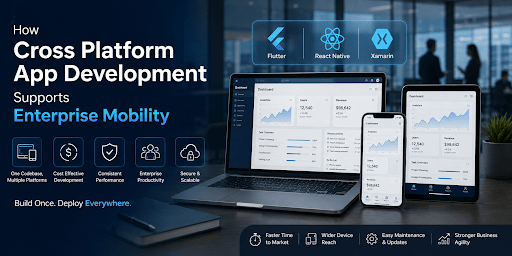
The core promise of cross platform development frameworks like Flutter, React Native, and Xamarin is that a single codebase produces applications that run across operating systems without duplicating engineering effort. For enterprise IT departments managing tight development budgets and longer release cycles, that efficiency matters enormously.
A utilities company that previously maintained separate iOS and Android versions of its field inspection app found that any change to inspection forms, a workflow adjustment, a new compliance field, required coordination across two separate development streams. Small updates that should have taken a week routinely stretched to three because both codebases needed separate testing and deployment. After migrating to a Flutter-based cross platform build, update cycles dropped by more than half. The same team shipped features faster with fewer resources, and both Android and iOS users received updates simultaneously rather than days apart.
Consistency matters beyond the development team. When field supervisors train new technicians on how to use a mobile tool, they want a single training protocol that applies regardless of which device someone is holding. Platform-specific UI quirks create confusion that compounds at scale.
Offline Functionality and Sync Architecture
Enterprise field workers frequently operate in environments where reliable connectivity isn’t guaranteed: underground facilities, remote construction sites, rural service areas, dense urban interiors where signal drops unpredictably. An application that simply fails to function without a live connection isn’t an enterprise tool. It’s a liability.
Cross platform frameworks now offer mature approaches to offline-first architecture, where the app stores data locally and syncs with backend systems when connectivity is restored. A construction management platform built on React Native implemented local SQLite storage for site inspections, allowing project managers to complete detailed reports, attach photos, and flag issues in areas with no signal. When they drove back within range, everything synced automatically and appeared in the central project dashboard within seconds.
Getting offline sync right requires careful attention to conflict resolution: what happens when two users update the same record offline and both try to sync. Enterprise cross platform apps that handle this gracefully, with clear merge logic and audit logs of what changed and when, give operations teams confidence that the data they’re seeing reflects reality.
Integration With Enterprise Systems
A mobile app that exists in isolation from the systems it’s supposed to support isn’t solving a mobility problem. It’s creating a new data silo. Enterprise cross platform development succeeds when it treats backend integration as a first-class requirement rather than a post-launch concern.
For most large organizations, that means connecting to ERP platforms like SAP or Oracle, CRM systems like Salesforce, identity providers like Azure Active Directory or Okta for single sign-on, and sometimes to legacy systems through middleware or custom APIs. A retail chain that deployed a cross platform inventory management app across its distribution centers built direct API integrations with its SAP backend, so stock adjustments made on a warehouse floor appeared in the central inventory system in real time. The alternative, manual reconciliation at end of shift, had been generating daily discrepancies averaging several thousand units across the network.
Security Architecture for a Mobile-First Workforce
Mobility introduces attack surface. Devices leave the building, connect to public networks, and sometimes get lost or stolen. Enterprise cross platform apps need security built into their architecture from the start, not added on as a layer after development is complete.
That means certificate pinning to prevent man-in-the-middle attacks on API communications, biometric authentication options that leverage the native capabilities of both iOS and Android, remote wipe integration with mobile device management platforms like Jamf or Microsoft Intune, and data encryption at rest for anything stored locally. Role-based access controls ensure that a field technician sees only the data relevant to their assigned jobs, while a regional manager gets the aggregate view their responsibilities require.
A logistics firm that rolled out a cross platform driver management application built all access controls through its existing Azure Active Directory groups, so when an employee’s role changed or their employment ended, their app access updated automatically without requiring a separate administrative step in the mobile platform.
The Real Return on Cross Platform Investment
Sofia’s field service company ran the numbers twelve months after the cross platform rebuild. The four hours of weekly administrative time per technician translated to recoverable capacity across the team. Data lag dropped from 24 hours to under 15 minutes on average. Dispatch decisions improved because the information driving them was current. And when the company added a customer signature capture feature six months after launch, it shipped to every technician on every device in a single update.
The return on cross platform development in enterprise mobility isn’t just about saving money on duplicate codebases. It’s about building a mobility foundation that adapts as the business changes, scales without requiring proportional increases in development resources, and gives every employee, regardless of what’s in their pocket, the same quality of tool to do their job with. For enterprises serious about mobility, that foundation is the difference between a collection of apps and an actual mobility strategy.
