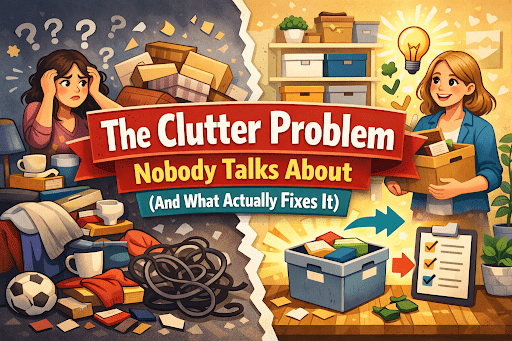
Most people don’t notice when clutter becomes a problem. It happens slowly: a pile here, a broken appliance there, a garage that gradually stops being a garage and starts being a storage unit you pay a mortgage on. By the time it feels overwhelming, it’s been building for years.
Clutter isn’t just an aesthetic issue, either. Studies consistently show that a disorganized living space raises cortisol levels, disrupts sleep, and makes it harder to focus. It creates low-level background stress that you stop consciously noticing but never stop feeling. You walk past the pile of stuff in the hallway fifty times a day without thinking about it, but your brain is registering it every single time.
The good news is that dealing with clutter, really dealing with it, not just shuffling things around, is one of the highest-return investments you can make in your home and your mental health. This guide walks through why clutter accumulates, how to approach it systematically, and when it makes more sense to bring in professional help rather than going it alone.
Why We Hold On to Things We Don’t Need
Before you can effectively declutter, it helps to understand why the stuff is there in the first place. And the answer is almost never laziness.
The “someday” trap. A lot of clutter is future-oriented: the exercise equipment you’ll use when you have more time, the craft supplies for a project you’ll eventually start, the spare parts for an appliance you’re going to fix. The objects aren’t really about the present. They’re placeholders for a version of your life that hasn’t happened yet.
Sunk cost thinking. Getting rid of something that costs money feels like admitting that money was wasted. So the treadmill that became a clothes rack stays in the bedroom because throwing it out means acknowledging the $800 wasn’t well spent. But keeping it costs you the space and the daily reminder — which is a real, ongoing cost that doesn’t show up on a receipt.
Inherited and gifted items. Objects given by people we love, or left by people we’ve lost, carry emotional weight that makes them almost impossible to part with rationally. They’re not really objects anymore. They’re representations of relationships, and getting rid of them feels like getting rid of the relationship.
Decision fatigue. Decluttering requires making a decision about every single item. Should I keep this? Donate it? Throw it out? For a home that’s accumulated years of stuff, that’s hundreds or thousands of small decisions and most people run out of decision-making energy long before they run out of things to sort through.
Understanding these patterns doesn’t make decluttering effortless, but it does make the resistance less mysterious. You’re not just fighting a mess. You’re fighting psychology. That’s a harder problem, and it deserves a more thoughtful approach.
A Practical Approach That Actually Works
The reason most decluttering attempts fail is that people try to do too much at once, run out of steam, and end up with the same amount of stuff just rearranged. Here’s a more realistic framework.
Start With the Low-Hanging Fruit
Don’t begin with the emotionally loaded stuff: the photos, the inherited furniture, the kids’ old toys. Start with items that have no sentimental weight: expired pantry items, duplicate kitchen tools, clothes you haven’t worn in two years and don’t particularly like. Clearing this category is faster, easier, and gives you momentum before you get to the harder decisions.
Getting a few bags out the door in the first session matters. It builds confidence and creates physical space — which makes the rest of the process feel more manageable.
Use the One-Year Rule (With Caveats)
The classic advice is: if you haven’t used it in a year, get rid of it. That’s a reasonable starting point, but it needs some nuance. Seasonal items skis, camping gear, holiday decorations obviously get used less than once a year. And some items are genuinely for emergencies: a spare tool, a first aid kit, a backup power bank.
Apply the one-year rule to everyday items and be honest about the exceptions. The question to ask is: if I didn’t own this and needed it, would I buy it again? If the answer is no, that’s your answer.
Sort Into Four Piles
When you’re working through a space, having four clear destinations makes the process faster:
Keep — things you use, love, or genuinely need.
Donate — items in good condition that someone else would actually use.
Sell — higher-value items worth the effort of listing (be realistic here; most things aren’t worth the time).
Dispose of — broken, worn out, or things with no resale or donation value.
The mistake most people make is adding a fifth pile: “I’ll decide later.” That pile grows until it is cluttered. Be decisive. If you genuinely can’t decide, set a thirty-day timer and put the item out of sight. If you haven’t thought about it in thirty days, you don’t need it.
Tackle One Room at a Time
Whole-house decluttering projects almost always collapse. The scope is too large, the decisions too numerous, and the fatigue sets in before visible progress is made. Work room by room — or even section by section within a room — and finish completely before moving on. The finished areas serve as visual reminders that the process works, which makes it easier to continue.
When DIY Decluttering Isn’t Enough
For moderate clutter, the approach above works well. But there are situations where it doesn’t — and trying to handle them yourself creates more frustration than progress.
Estate cleanouts. Clearing a home after a death or a move to care housing is one of the most emotionally and physically demanding tasks a person can face. The volume of belongings is typically large, many items carry emotional weight, and the timeline is often tight. Doing this alone or with family, where disagreements about what to keep can create real conflict is genuinely hard.
Post-renovation debris. A bathroom remodel, a kitchen upgrade, or any significant construction project generates a significant amount of material: old fixtures, drywall scraps, tile, lumber, packaging. This isn’t the kind of thing you can stuff in your bins on collection day, and it tends to sit in a pile in the driveway or garage for months.
Hoarding situations. When clutter has moved from a home improvement problem to something more serious, the volume of items involved is often too large for a standard DIY approach. There may also be safety concerns, unstable piles, pests, items that have been compromised by moisture or damage that make it genuinely unsafe to work through alone.
Large furniture and appliances. Old sofas, broken refrigerators, mattresses, exercise equipment are heavy, awkward, and often can’t go in regular trash. Getting them out of the house, into a vehicle, and to an appropriate disposal facility is a significant physical undertaking that most people simply aren’t set up to do.
In all of these situations, professional junk removal is often the most practical solution. It’s not the most glamorous option, and it costs money but it saves time, physical effort, and in some cases, significant stress.
What Professional Junk Removal Actually Involves
A lot of people have a vague idea of what junk removal services do, but haven’t used one. Here’s what the process typically looks like.
You schedule a pickup usually same-day or next-day for most services. The crew arrives, you show them what needs to go, and they handle the heavy lifting, loading, and hauling. You don’t need to move anything to the curb or sort it beforehand. Most reputable services will sort items for donation and recycling where possible, rather than sending everything to a landfill.
For Bay Area residents dealing with larger cleanouts, services in specific cities have become increasingly easy to access. Residents in San Ramon, for instance, have access to reliable removal services that handle everything from single-item pickups to full property cleanouts useful whether you’re clearing a garage before a sale or disposing of the remains of a renovation. Similarly, homeowners in Livermore tackling old appliances, furniture, or accumulated debris have found that efficient Livermore hauling makes the difference between a project that gets done and one that sits on the to-do list for months. And for those further into the peninsula,professional Redwood City disposal covers the kind of heavy, awkward items old patio furniture, broken gym equipment, construction waste that simply aren’t practical to handle alone.
Pricing varies by volume and type of material, but for most jobs, the cost is significantly lower than people expect and significantly lower than the ongoing cost of leaving the clutter in place.
The Decluttered Home: What Changes
It’s worth being clear-eyed about what decluttering does and doesn’t do. It doesn’t fix structural problems in a home. It doesn’t solve financial stress or relationship difficulties. It doesn’t make a bad neighborhood safer or a small space magically larger.
What it does do is remove a source of low-level friction that affects more of your daily life than you probably realize. Getting dressed in the morning is easier when you can see your wardrobe. Cooking is faster when your kitchen is organized. Working from home is more productive when your desk isn’t buried. Finding things keys, documents, tools stops being a small daily frustration.
More than any of that, there’s something that happens to the way a space feels when it’s genuinely cleared. It’s hard to describe if you haven’t experienced it, but it’s real. The air feels different. The rooms seem larger. The house starts to feel like somewhere you chose to be, rather than somewhere you’re managing.
That shift is worth the effort of getting there however you get there.
Getting Started This Week
If you’ve read this far and you’re still feeling stuck, here’s the simplest possible starting point: pick one drawer. Not a room, not a category one drawer. Empty it completely, keep only what you actively use, and close it. That’s it for today.
Tomorrow, pick another one.
The momentum builds faster than you’d think. Most people who start this way end up going further than they intended, because the process of clearing space is genuinely satisfying once you start. The hardest part isn’t the work it’s starting.
So start small. Start somewhere. And if the project turns out to be bigger than one person with one afternoon can handle, don’t hesitate to call in help. That’s not giving up. That’s making a practical decision to actually get it done.
Looking for more home improvement and lifestyle content? Explore the rest of the Daily Bizz blog for practical guides on making your home and your daily routine work better for you.
