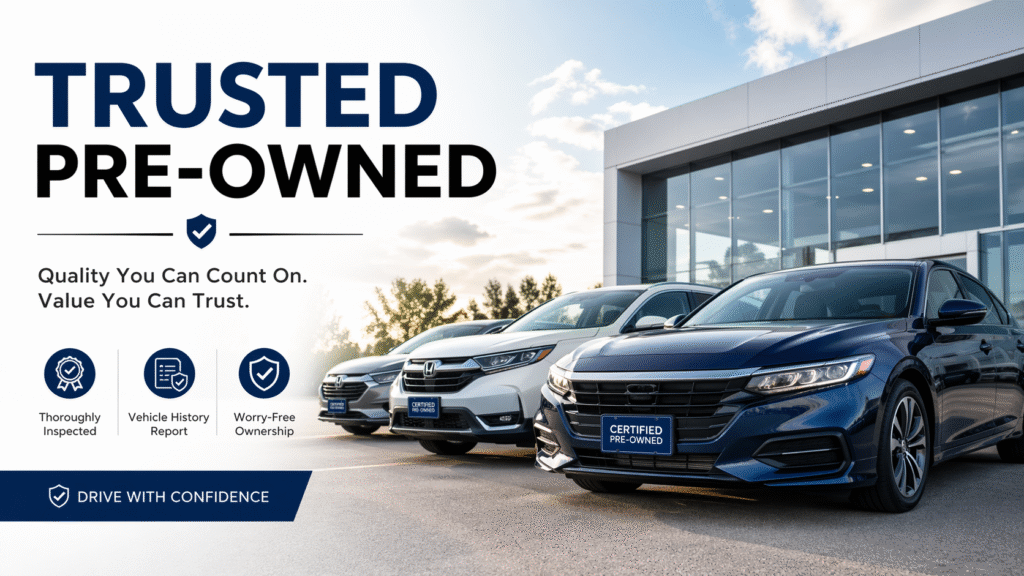
Why choose a trusted pre-owned car sales in the UK over a private seller comes down to one word. Protection.
I have helped hundreds of buyers navigate the used car market. The difference between a smooth purchase and a costly nightmare is almost always the seller.
A trusted pre-owned dealer offers warranty coverage, accurate vehicle history, transparent pricing, and legal protection. A private seller offers none of these.
This guide explains why certified pre-owned programmes save you money, time, and stress. If you are ready to buy with confidence, a verified Trusted Pre-Owned Car Sales network can connect you with approved dealers who have already inspected and certified every vehicle on their lot.
What Are Trusted Pre-Owned Car Sales?
These are vehicles sold through manufacturer-approved programmes. Think Audi Approved Used, BMW Premium Selection, or Toyota Approved Used.
Some independent dealers who are members of the Retail Motor Industry Federation or the Motor Ombudsman also qualify.
Not every dealer claiming to be “trusted” actually is. That is why knowing the difference matters.
The Trusted Dealer vs. Private Seller Comparison
Here is the clearest way to see what you actually get from each seller type.
| Seller Type | Warranty | History Check | Consumer Rights | Price Premium |
| Manufacturer-approved used | 12 to 24 months | Full, multi-point inspection | Full legal protection | plus 10 to 20 per cent |
| RMI registered independent | 3 to 12 months | Usually full | Full legal protection | plus 5 to 15 per cent |
| Private seller | None | Unknown | Sold as seen | 0 per cent |
| Auction | None | Buyer beware | Very limited | minus 10 to 20 per cent |
A real story. A customer bought a 2019 Volkswagen Golf from a private seller for £12,000. A good price. Two weeks later, the gearbox failed. The seller disappeared. The repair cost £2,800.
Another customer bought the same model from an approved used dealer for £13,500. A minor electrical fault appeared. The dealer fixed it under warranty at no cost. The £1,500 premium paid for itself.
What You Actually Get from a Trusted Dealer
A trusted dealer gives you things a private seller cannot.
First, a comprehensive inspection. Manufacturer-approved programmes typically include 100 to 200 checks. They look at the engine, gearbox, brakes, and suspension. They check every light, window, and sensor. They measure paint depth and check for accident damage. They verify the service history and mileage.
A private seller gives you none of this. You are on your own.
Second, warranty coverage that actually protects you. Most manufacturer warranties last 12 months with unlimited miles. They cover the engine, gearbox, electrics, and suspension. Some brands, like Toyota, also cover the hybrid battery.
Third, transparent vehicle history. You get full service records. You get an HPI check proving no outstanding finance, not stolen, and not written off.
You get MOT history and a multi-point inspection report. A private seller might give you a folder of old papers. Or nothing at all.
The Hidden Costs of Buying from Private Sellers
Buying privately might seem cheaper upfront. Here is what you often pay later.
| Hidden Cost | Typical Amount |
| Undisclosed accident damage repair | £500 to £5,000 |
| Clutch replacement | £400 to £800 |
| Timing belt replacement | £300 to £600 |
| Gearbox repair | £1,000 to £3,000 |
| Faulty air conditioning | £200 to £600 |
| Four new tyres | £300 to £600 |
Another real story. A customer bought a 2017 Nissan Qashqai privately for £9,000. The car looked clean. Three months later, the clutch slipped. Six months later, the air conditioning failed. The total repair bill over 12 months was £1,400.
He could have bought the same car from a trusted dealer for £10,200. That came with a 12-month warranty covering both issues. The private bargain cost him more.
How to Identify a Genuinely Trusted Dealer
Not every dealer who says “trusted” actually is. Look for these credentials.
Membership in the Motor Ombudsman means they are accredited and offer dispute resolution. You can search their online register. Membership in the Retail Motor Industry Federation means they follow industry standards. Ask for their membership number.
AA Approved Dealer status means they have been audited by the AA. Check on the AA website. A Trustpilot score of 4.0 stars or higher shows a customer-verified reputation. Read recent reviews. A Google score of 4.5 stars with 50 or more reviews shows local reputation.
Walk away from certain red flags. A dealer who says “no warranty, sold as seen” is avoiding legal obligations. Cash-only payment requests mean tax avoidance and no paper trail.
No physical showroom address means they could disappear overnight. Pressure to buy immediately usually means they are hiding something.
If they cannot provide an HPI check or service history, the car may have hidden finance or damage. If the V5C logbook is not in the dealer’s name, they may be trading as a private seller to avoid responsibilities.
Questions to Ask Before You Buy
Ask these questions directly. A good dealer will answer happily.
Is this car part of a manufacturer-approved used programme?
What warranty is included, and what does it cover?
Can I see the multi-point inspection report?
Has an HPI check been completed? Can I see it?
What is your returns policy?
Are you registered with the Motor Ombudsman?
Can I take the car for an independent inspection? A trusted dealer will say yes.
2026 Updates for Pre-Owned Car Sales
Some things have changed this year.
Digital service histories are now standard. Most manufacturers use DVLA-linked digital records. They are harder to fake than paper books.
For electric vehicles, approved used programmes now include battery state-of-health reports. Always ask for this before buying an EV.
The Right to Repair rules have expanded. Independent garages can now access manufacturer diagnostics. This keeps servicing costs down even for approved used cars.
Consumer rights have been clarified. You now have up to six years to claim for pre-existing faults on used cars.
MOT certificates are digital by default. Check the MOT history online before viewing any car. It is free on the GOV.UK website.
Most manufacturer warranties now transfer to new owners automatically. Verify the transfer terms before completing your purchase.
Cost Comparison – Trusted Dealer vs. Private Sale
Let us look at real costs over 24 months for a 2019 Ford Focus.
| Cost Item | Trusted Dealer | Private Sale |
| Purchase price | £12,500 | £11,000 |
| Warranty | Included | £300 (if bought separately) |
| Unexpected gearbox repair | £0 (warranty covers) | £1,200 |
| MOT and advisory repairs | £100 | £250 |
| Total cost of ownership | £9,250 | £9,400 |
The private sale savings of £1,500 upfront disappeared within 24 months. The trusted dealer car costs less overall.
Final Thoughts
Why choose a trusted pre-owned car sales in the UK is not a question of budget. It is a question of risk.
Yes, you pay a premium compared to a private sale. But that premium buys you a multi-point inspection. A meaningful warranty. Accurate history. And legal protection under the Consumer Rights Act.
Here is a simple guide.
If you are a first-time buyer with limited car knowledge, go with a manufacturer-approved used car. If you are buying a car over £10,000, use a trusted dealer with a warranty.
If you are buying a car under £5,000, a private sale may be acceptable because the risk is lower. If you are buying an EV, choose approved used with a battery health report.
A car is likely the second most expensive purchase you will ever make. Protect that investment. Buy from a seller who stands behind what they sell.
When you are ready to buy, a verified Trusted Pre-Owned Car Sales network can connect you with approved dealers who have already done the hard work. Drive away with confidence. Not regret.
